Menu

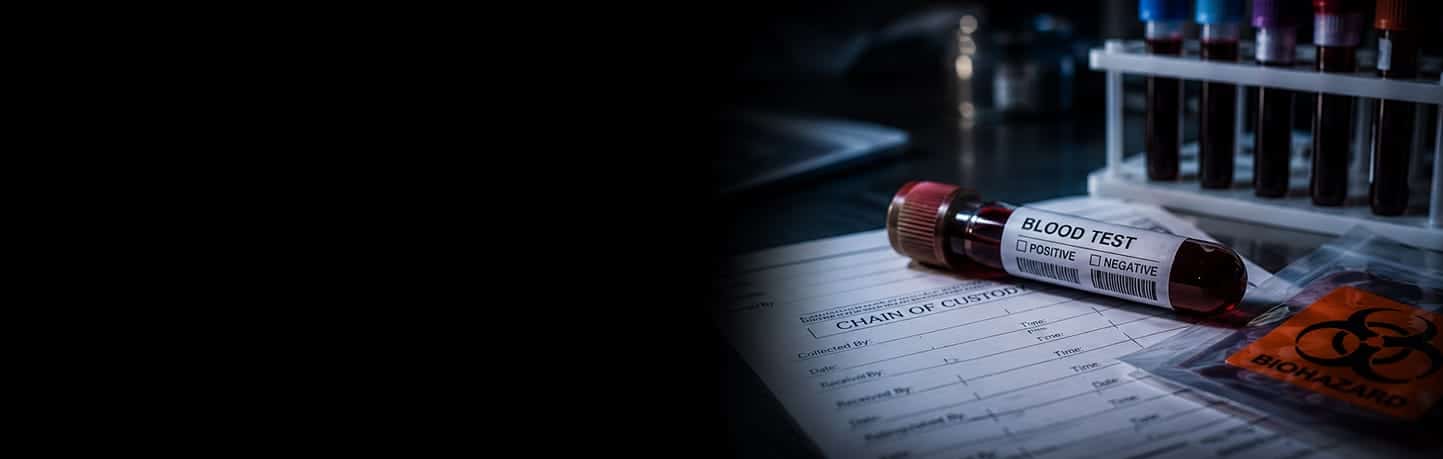
What the Lab Found and What It Proves Are Two Different Things.
A blood test result in a DWI case carries significant weight. Prosecutors present it as objective scientific evidence, a laboratory measurement of alcohol or drugs in the blood at the time of the draw.
What that framing leaves out is everything that happened before the result existed: how the blood was collected, how it was stored, how it was transported, how it was analyzed, and whether every step in that chain was handled correctly. Each stage creates its own set of issues. And unlike a breath test, which produces an immediate result at the scene, blood evidence passes through multiple hands and multiple processes before it ever reaches a courtroom.
At Denuna & Westbrook, PLLC, we examine blood test evidence at every stage, from the draw itself to the laboratory report, to determine its reliability.
A breath test produces a result at the scene within minutes. A blood test result may not exist for weeks or months after the arrest. The sample must be collected, preserved, transported, logged, stored, and analyzed by a laboratory before a number appears.
That process creates opportunities for error that simply don’t exist in breath testing. Contamination, mislabeling, improper preservation, storage temperature issues, and analytical errors can all affect the final result, and none of them leave obvious marks on the number that gets reported.
Blood evidence is only as reliable as the chain of custody behind it. From the moment a sample is drawn to the moment it is analyzed in a laboratory, every transfer, every storage condition, and every person who handled the sample must be documented.
The collection process itself raises specific issues worth examining:
A break anywhere in that chain creates a legitimate challenge to whether the sample analyzed in the laboratory was handled in a way that preserves its integrity.
Many DWI blood draws occur at hospitals rather than jails, particularly in accident cases. Hospital blood draws create a separate set of issues that don’t apply to draws conducted by law enforcement.
Hospital blood is drawn for medical purposes, not criminal prosecution. The procedures, preservatives, and collection methods may differ from those required for forensic analysis. A hospital draw may be taken from a different site, using different equipment, under different conditions than a law enforcement draw. Whether a hospital blood draw satisfies the requirements for use as criminal evidence requires careful analysis of how and why the sample was collected.
In some DWI cases involving car accidents, blood may be drawn for medical purposes before law enforcement makes any formal request. The circumstances under which that blood was obtained, and whether it was later accessed by law enforcement with proper legal authority, may become significant issues in the defense. (→ DWI Accidents & Injuries)
When blood is drawn at a hospital for medical purposes, the result differs from forensic testing, and that difference can be significant.
Forensic blood testing analyzes whole blood using gas chromatography. Hospital labs, on the other hand, test serum, which is what remains after the blood is centrifuged and the red blood cells, white blood cells, platelets, and clotting proteins are removed. Serum is a different substance, and it produces a different result.
Why does this distinction matter in DWI cases? Alcohol is hydrophilic, meaning it moves toward and concentrates in water. Whole blood is approximately 80% water. Serum is approximately 92% water. Because serum contains more water than whole blood, alcohol concentrates there at a higher level. Research consistently shows that serum results run 16 to 25 percent higher than the true whole blood alcohol concentration.
In practical terms, a hospital serum result of 0.10 may reflect a true whole blood BAC of only 0.08 to 0.086, potentially right at or below the legal limit. A serum result that appears to show clear intoxication may significantly overstate what the forensic standard would actually show.
Hospitals also use enzymatic testing, which is designed for a medical diagnosis, not for a criminal prosecution. Enzymatic testing is considered a screening method that should be confirmed by gas chromatography before being used as evidence. Hospital labs don’t perform that confirmation. The testing method, the sample type, and the purpose of the analysis are all fundamentally different from what a forensic lab does.
When the State attempts to use a hospital blood result in a DWI prosecution, the conversion from serum to whole blood, the testing methodology, the reliability of the result, and whether the sample even qualifies as a blood test under Texas law all become legitimate and powerful defense issues.
When a blood sample reaches a forensic laboratory, it undergoes a process called gas chromatography to determine alcohol concentration. Understanding how that process works is essential to evaluating whether the result is reliable.
Gas chromatography doesn’t directly analyze the blood itself. Instead, a small portion of the sample is placed in a sealed vial and heated. The alcohol and other volatile compounds in the sample vaporize into the space above the liquid, a process called headspace analysis. The gas in that space is then injected into the chromatograph, which separates and identifies the compounds present based on how quickly they move through a heated column.
The result is a measurement of alcohol concentration in the headspace vapor, which is then converted into an estimated blood alcohol concentration using mathematical assumptions. In breath testing, a similar conversion occurs through what's called the partition ratio, a fixed mathematical assumption about the relationship between breath alcohol and blood alcohol that varies from person to person. The same principle applies here: the conversion from headspace vapor to blood alcohol concentration is an assumption, not a direct measurement, and assumptions can be wrong.
The gas chromatography process depends on equipment that must be properly maintained and calibrated, analysts who must follow established procedures, and samples that must arrive in proper condition. Each creates potential issues worth examining:
There is also a compound called n-propanol that appears naturally in decomposing blood. If a blood sample wasn’t properly preserved or stored at incorrect temperatures, fermentation can occur, meaning the blood itself can produce alcohol after collection. In other words, the reported BAC may reflect sample degradation rather than actual intoxication at the time of driving.
Even a properly collected and accurately analyzed blood sample only measures alcohol concentration at the time of the draw, not at the time of driving.
In most DWI cases, blood is drawn well after the arrest, which itself occurs after the stop. If alcohol was still being absorbed at the time of driving, the BAC at the time of the draw may actually be higher than it was behind the wheel. Prosecutors sometimes attempt to account for this through retrograde extrapolation, working backward from the draw result to estimate BAC at the time of driving. Those calculations depend on assumptions about drinking patterns, absorption rates, and elimination rates that may not be supported by the actual evidence.
Blood test defense requires a level of scientific understanding that goes beyond reviewing a laboratory report. It requires knowing how gas chromatography works, what proper laboratory procedure looks like, where the analysis is most vulnerable to error, and how to challenge the result in terms a jury can understand.
Chris Denuna holds the Forensic Lawyer-Scientist designation from the American Chemical Society’s Chemistry and the Law Division, with advanced training through Axion Analytical Labs in gas chromatography, blood alcohol analysis, and forensic laboratory methodology. That training allows Denuna & Westbrook to examine blood test evidence at a level most defense attorneys never reach, reviewing the chromatograms themselves, evaluating the laboratory’s quality control records, and identifying analytical issues that don’t appear on the surface of a laboratory report.
Blood test defense requires a level of scientific understanding that goes beyond reviewing a laboratory report. Chris Denuna holds the ACS Forensic Lawyer-Scientist designation, with hands-on laboratory training through Axion Analytical Labs in gas chromatography and forensic blood alcohol analysis. That training gives us the foundation to challenge the science, not just the number on the report.
Nick Westbrook and Chris Denuna have challenged blood test evidence in cases ranging from borderline results to high BAC readings where laboratory procedure, chain of custody, and sample integrity were all in dispute.
Is a blood test result more accurate than a breath test?
Not necessarily. Blood testing involves its own set of variables including collection procedures, preservation, chain of custody, and laboratory analysis. A blood result is only as reliable as every step that produced it.
Can blood test results be challenged?
Yes. Collection procedures, chain of custody, laboratory methodology, instrument calibration, analyst qualifications, and the timing of the draw relative to driving are all legitimate defense issues.
What if my blood was drawn at a hospital?
Hospital blood draws may not follow the same procedures required for forensic analysis. Whether a hospital draw satisfies the legal and scientific requirements for use as criminal evidence depends on the specific circumstances.
What does the laboratory actually measure from a blood sample?
The laboratory measures alcohol in the vapor above the blood sample using gas chromatography. The result is then converted into an estimated blood alcohol concentration using mathematical assumptions. Whether those assumptions hold up in your specific case depends on how the sample was collected, handled, and analyzed – and that's exactly what our firm examines in these cases.
Can blood ferment after collection?
Yes. If a sample isn’t properly preserved or stored, the blood itself can produce alcohol through fermentation, potentially inflating the reported BAC.
What if the blood draw happened hours after the arrest?
The draw result reflects BAC at the time of the draw, not at the time of driving. The timing difference may be significant depending on when alcohol was consumed and whether absorption was complete at the time of the stop.
Behind every blood test result is a collection process, a chain of custody, a laboratory analysis, and a set of assumptions. Any one of them can affect what the number actually means.
Denuna & Westbrook, PLLC represents individuals facing DWI blood test cases throughout Houston and the Gulf Coast region, including Harris County, Fort Bend County, Montgomery County, Galveston County, Brazoria County, and Waller County.
Call 713-966-0253, email info@texasdwlaw.com, or reach out online to schedule a confidential consultation.
© 2026 Denuna & Westbrook, PLLC
| View Our Disclaimer | Privacy Policy
Law Firm Website Design by The Modern Firm